In my previous post, I talked about how for 2022, I wanted to adopt the methods of Atomic Habits to help me in achieving my goal. Instead of focusing on specific outcomes and make goals, I shifted my starting point to first figure out what kind of person I want to be. This is an identity-based approach, as opposed to an outcome-based approach.
This post elaborates on the first out of four aspects of my new identify, to be a YA Fantasy author and author of children’s books.
What type of person is an author?
The very obvious answer of course, is that this person needs to write… and publish them somewhere for others to consume. In order to have publishable material, this person needs to write a first draft and as many subsequent drafts required to make the book the best that they can make. Then, this person needs to do it all over again.
In order for that to happen, this person needs to commit a significant amount of time to writing. The simplest piece of habit I will focus on, of course, is to somehow make enough time for myself to write, and to write consistently.
I will need to apply the Four Laws of Behavioral Change to the habit of consistent writing:
| How to create a good habit | |
| 1st Law (Cue) | Make it obvious |
| 2nd Law (Craving) | Make it attractive |
| 3rd Law (Response) | Make it easy |
| 4th Law (Reward) | Make it satisfying |
1st Law (Cue): Make it obvious
Pointing and Calling: The process of behavior change starts with awareness. I will employ pointing and calling to make sure I am aware of when I am not writing. Whenever there is a writing opportunity, I will physically call out that it is a potential opportunity to write, and why I am not doing so. Ideally, I’d like to write down for at least two weeks and check back here on all the identified writing opportunities, and which ones I was to take and which ones I missed.
Examples:
- Kids are asleep, this is a writing opportunity. I am not writing because I decided to watch a movie with my husband.
- This is a writing opportunity. I am not writing because I need to sleep.
Time, Location, and Habit Stacking: The most common cues are time and location, which is to fill out the following:
I will [Behavior] at [Time] and [Location]
Habit stacking involves using an existing established habit as a cue. For my current life, a [Time] cue is unpredictable since it changes from day to day. Instead, I will use a current habit as the cue. Based on the above, I have the following:
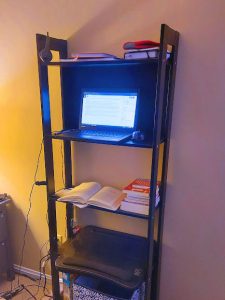
I will write for 30 minutes after lunch on my laptop at my “standing desk” (it’s a bookshelf…)
I will write after kids’ bedtime on my laptop at my “standing desk”
A note about the standing desk: At the time of writing, I have a young child who I will need to babywear while writing. Standing up allows me to rock them back and forth, which will help in giving me enough time to write.
Environment: It’s easier to set up new habits in new environments because they aren’t competing against old cues. This has already been established, as I have repurposed a bookshelf as my new writing shelf. It is used for nothing but writing, and has no distractions.
2nd Law (Craving): Make it attractive
Since the more attractive an opportunity is, the more likely it is to become habit-forming, I have to figure out a way to make writing attractive.
I already enjoy writing and immersing myself in my story worlds, but is it enough to compete against Netflix, social media, board games, and just plain goofing off?
It appears the answer lies in dopamine dopamine dopamine! In order to create an anticipation, I will apply the habit stacking and the temptation bundling formula:
After [Current habit], I will do [habit I need]
After [habit I need], I will do [habit I want]
Therefore, building on what I have in the 1st Law:
After writing for 30 minutes after lunch, I will spend time engaging in social media
After writing after the kids go to bed, I will read from my favorite books
Social Norms: The book also speaks about conforming to social norms. In order to build better habits is to join a culture where your desired behavior is the norm. I have already started to implement this in a few ways:
- I am part of a Mom’s writer group that does regular (daily) check-ins and writing sessions where I can join and write with like minded people
- I am part of a small writing circle where we will check in on each other and be each other’s accountability partners and cheerleaders
3rd Law (Response): Make it easy
Repetition, not duration: The third law states that the point of forming a habit is to make a behavior progressively more automatic through repetition. This means that it’s more important to show up and do the act than to plan it, or even the duration of it. The amount of time you have performed it is not as important as the number of times you have done it.
By that statement, I am taking away the time restraint from the above statements in 2nd Law.
Reduce friction: In order to increase the success of habit formation, I will have to reduce the friction of wanted behavior. That is, my environment should be where doing the right thing is as easy as possible.
When I was practicing the fiddle for the next orchestra performance, I found that leaving my fiddle out in plain sight and the sheet music all set up on the stand was the best way to ensure that I would pick it up and practice at every opportunity. If I had put everything away, then the very act of having to take everything out and set it up was enough resistance to stop me.
In this case, I have set up my writing space to be as easily accessible as possible. I have repurposed a bookshelf by my bed where I can write. It is a standing situation to facilitate baby wearing while writing and also to ensure I don’t fall asleep (as that is a distinct likelihood, given young children).
I also take my writing stuff with me every time I leave the house so I can write in the car, and write at my parents’ house. This is not to say I will for sure have time to write, but I want to be prepared should the opportunity present itself.
The 2 Minute Rule: When you start a habit, its best to start small. Standardize before you optimize. You can’t improve a habit that doesn’t exist. The more you ritualize the beginning of a process, the more likely it becomes a habit that will stick.
Given that, I need to break my habits down into phases and start small. Therefore, phase 1 of my writing habit should be just to turn on the computer and write something during the times that I said I will write. Something is better than nothing.
4th Law (Reward): Make it satisfying
Human beings evolved to prioritize immediate rewards over delayed rewards. So to get a habit to stick, I need to feel immediately successful in some way. This 4th Law is here to make sure that the habit gets repeated.
One of the most satisfying feelings is the feeling of making progress. Cue the habit tracker. For now, I will be focusing on just showing up. I am aiming to write three times a week. Monday, Wednesday, Friday. When I have turned on the computer and put any words into my manuscript, I get a sticker!
Habit Contract: A habit contract will add a social cost to not completing a specific habit. This is also why having accountability partners is generally a good idea. As I have previously mentioned above, I have recently joined a writing circle. These ladies are there to help keep my accountable, and vice versa. As well, I consider blogging my progress on this habit as part of my habit contract with the world.
Although this blog isn’t particular popular (now), my hope is that that will change. But just the potential of someone watching is already a great motivator for me.
Summary
- After identifying that the new version of me wants to be an author, the main habit for me to build is to consistently write
- By applying the Four Laws of Behavioral Change (Cue, Craving, Response, Reward), I built out some parameters to help me to build a habit of writing consistently
- The parts of creating habits that stick involve making it obvious, making it attractive, making it easy, and making it satisfying
- The habits from consistent writing are currently phrased as follows:
I will write after lunch on my laptop at my “standing desk”. After writing something, I will spend time engaging in social media.
I will write after the kids’ bedtime on my laptop at my “standing desk”. After writing something, I will read a bit from my favorite books.
- If you’re interested in giving this a shot, check out www.atomichabits.com